Grace Nyahangare’s Mother of One Exhibition Reframes Single Motherhood at First Floor Gallery Harare
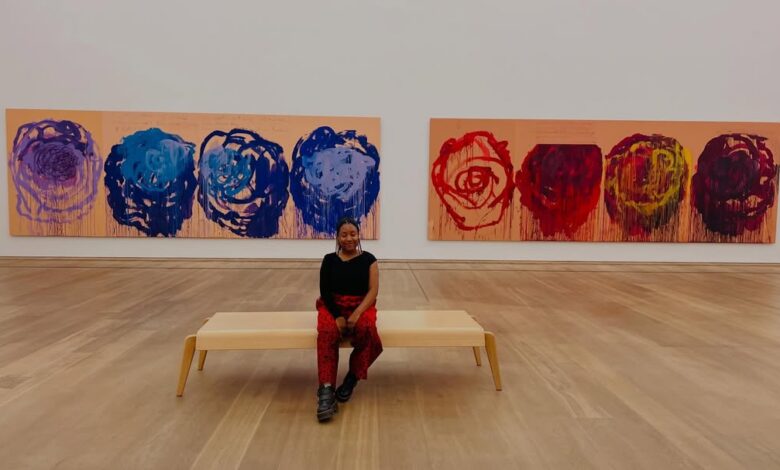
Grace Nyahangare’s recent exhibition Mother of One at First Floor Gallery Harare marks a decisive shift in how single motherhood is represented in contemporary visual art. The exhibition moves away from the usual online commentary and social media-driven stereotypes that often reduce single mothers to simplistic labels. Instead, Nyahangare presents a body of work that is grounded, reflective and emotionally layered. Her approach challenges public perception by focusing on lived experience rather than opinion or judgment. The result is an exhibition that feels both personal and socially relevant, especially in a cultural environment where narratives about motherhood are often shaped by influencers and viral commentary. Her work positions art as a space for dignity, reflection and emotional truth.
Nyahangare’s earlier solo exhibition at First Floor Gallery Harare in 2023, titled Hatikanganwe Asi Tinopora (We Do Not Forget but We Heal), explored themes of grief, memory and personal struggle. That body of work was deeply introspective and revealed the emotional weight of healing from difficult experiences. With Mother of One, her artistic direction shifts forward, moving from trauma into a more resolved and self-aware expression. The piece Kukurukura hunge wapotswa (I Lived to Tell the Tale) reflects this transition clearly, capturing the strength that comes from survival and reflection. Her evolution as an artist is visible in how she now approaches identity and motherhood with more clarity and confidence. The shift signals not only personal growth but also a broader commentary on resilience.
In Mother of One, Nyahangare places women at the centre of the narrative, particularly those raising children alone. The exhibition title itself reclaims a term often used with judgment or misunderstanding. Instead of allowing it to remain a label of stigma, she transforms it into a symbol of strength and lived responsibility. Her work refuses to separate women into categories defined by marital status or social expectation. In pieces such as Mukadzi pa Vakadzi (A Woman among Women) and Ticheneke (Let Us Shine), she presents women as unified, powerful and self-aware individuals. The imagery communicates confidence that comes from experience rather than idealised representation. Her work speaks directly to women who understand the complexity of care, responsibility and survival.
The exhibition also challenges the tone of online spaces where single mothers are often ridiculed or misunderstood. Nyahangare avoids confrontation in her visual language and instead uses symbolism and emotional depth to reshape perception. Works such as Amai 2 honour motherhood without conditions or social qualifiers. In Amai 1, the figure is depicted with a halo, reinforcing the idea that motherhood carries inherent value regardless of circumstance. These artistic choices reject the idea that motherhood must be validated through social approval or traditional structures. Instead, she presents it as a universal role defined by care, sacrifice and emotional labour. Her work builds empathy rather than division.
A notable work in the exhibition, Lulu, uses abstraction to explore the intimacy between mother and child. The simplified facial forms and surrounding patterns suggest both a swaddled infant and symbolic references to the womb. The piece captures early childhood affection and the deep emotional bond that forms between mother and child. The title, often used as a pet name for a child still learning to speak, adds a layer of tenderness and familiarity. Through this work, Nyahangare highlights the emotional intensity of motherhood, including the often unseen moments of care and protection. The piece invites viewers to consider the depth of connection that defines early life relationships.
Nyahangare’s work also acknowledges the broader cultural understanding of motherhood in Zimbabwean society. The term amai extends beyond biological mothers and includes stepmothers, aunts and other female caregivers who play maternal roles. Her exhibition reflects this expanded definition and challenges narrow interpretations of motherhood. The visual language she uses, including merging bodies and layered forms, reflects the complexity of these relationships. Figures in her work sometimes appear intertwined or fragmented, suggesting emotional and psychological depth. These artistic choices reinforce the idea that motherhood cannot be reduced to a single definition or experience.
Through Mother of One, Grace Nyahangare establishes herself as an artist focused on emotional truth and social reflection. Her work does not rely on shock value or commentary but instead builds meaning through symbolism and lived experience. The exhibition offers a counterpoint to digital narratives that often oversimplify or distort personal realities. By focusing on single motherhood with sensitivity and depth, she creates space for empathy and understanding. Her work ultimately elevates the subject beyond stereotype and criticism, presenting motherhood as a layered and powerful human experience.