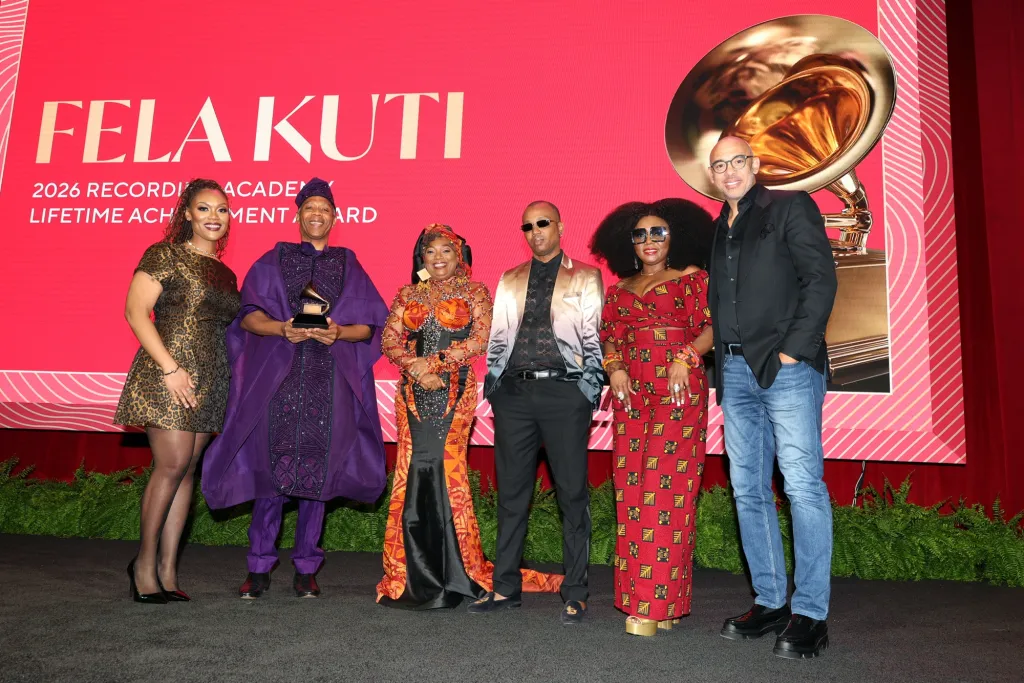
Fela Kuti Receives Posthumous Grammy Lifetime Achievement Award
Long hailed by fans as the King of Afrobeat, Nigerian musician Fela Kuti has finally been recognised by the global music industry. Almost three decades after his death at 58, he received a posthumous Lifetime Achievement Award at the Grammys. Seun Kuti, Fela’s son, described the award as “bringing balance to a Fela story” and a recognition that had long been overdue. Rikki Stein, a longtime friend and manager, added that the honour was “better late than never” and reflected a growing global appreciation for African music.
The award comes amid the global rise of Afrobeats, a genre inspired by Fela’s sound. The Grammys introduced the Best African Performance category in 2024, and Fela is the first African to receive a Lifetime Achievement Award posthumously. Other recipients this year included Carlos Santana, Chaka Khan, and Paul Simon. Fela’s family and colleagues attended the ceremony to accept the honour.
Fela Kuti was more than a musician. He was a cultural theorist, political agitator, and pioneer of Afrobeat alongside drummer Tony Allen. His music combined West African rhythms, jazz, funk, highlife, extended improvisation, call-and-response vocals, and politically charged lyrics. Over three decades, he released more than 50 albums that fused ideology with rhythm and protest with performance.
Fela often clashed with Nigeria’s military governments. In 1977, after releasing Zombie, which satirised soldiers, his compound, the Kalakuta Republic, was attacked, burned, and residents brutalised. His mother, Funmilayo Ransome-Kuti, later died from injuries sustained during the assault. Fela responded through music and defiance, notably in Coffin for Head of State.
His ideology blended pan-Africanism, anti-imperialism, and African-rooted socialism. Influences included his mother and US-born activist Sandra Izsadore. Born Olufela Olusegun Oludoton Ransome-Kuti, he dropped “Ransome” to reject Western roots. In 1978, he married 27 women in a publicised ceremony that reflected the communal vision of Kalakuta Republic.
Fela endured repeated arrests, censorship, and beatings, yet repression only strengthened his influence. Stein highlighted Fela’s focus on liberation, stating he “wasn’t doing what he was doing to win awards. He was interested in freeing the mind.” Fela’s musical evolution was shaped by both Nigeria and Ghana. Highlife music, pioneered by Ghanaian musicians like ET Mensah, influenced his early style. He merged highlife’s melodic structure with jazz, funk, Yoruba rhythms, and political storytelling, creating Afrobeat as a distinct West African and diasporic sound.
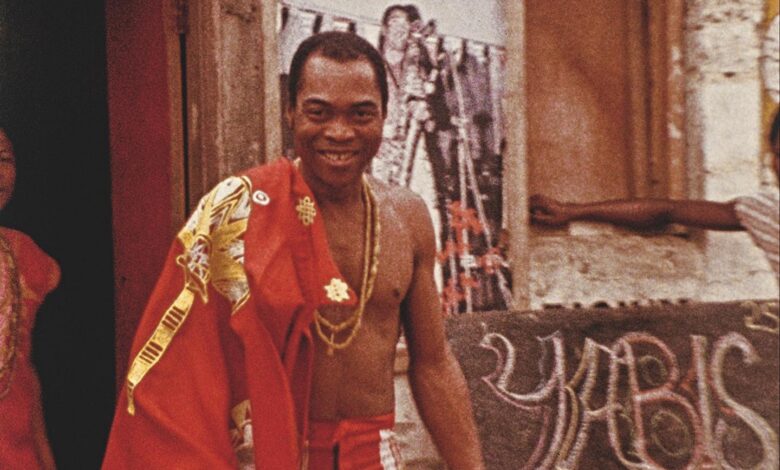
On stage, Fela commanded attention. Often bare-chested or draped in West African fabrics, with a crisp Afro and saxophone in hand, he led bands of more than 20 musicians. His performances at the Afrika Shrine in Lagos were immersive experiences, blending concert, political rally, and spiritual ceremony. Artist Lemi Ghariokwu created 26 of Fela’s album covers, shaping his visual identity. Fela Kuti’s legacy remains powerful. Millions worldwide continue to listen to his music, and modern artists such as Burna Boy, Kendrick Lamar, and Sir Idris Elba cite him as an influence. Elba has curated an official Fela vinyl box set, comparing him to icons like Sade and Frank Sinatra.
Seun Kuti, who was 14 when his father died, remembers Fela not for spectacle but for discipline, clarity, and humanity. “Fela belonged to himself. But we all belonged to him,” he said, highlighting the balance between independence and communal responsibility that defined his father’s life. Fela Kuti’s posthumous Grammy is more than an award. It is recognition of a life dedicated to music, political advocacy, and cultural leadership, and a reminder of his enduring influence on African and global music.