Kushambidzwa: Lines of Discomfort Explores Vulnerability and Social Order at Mbare Art Space
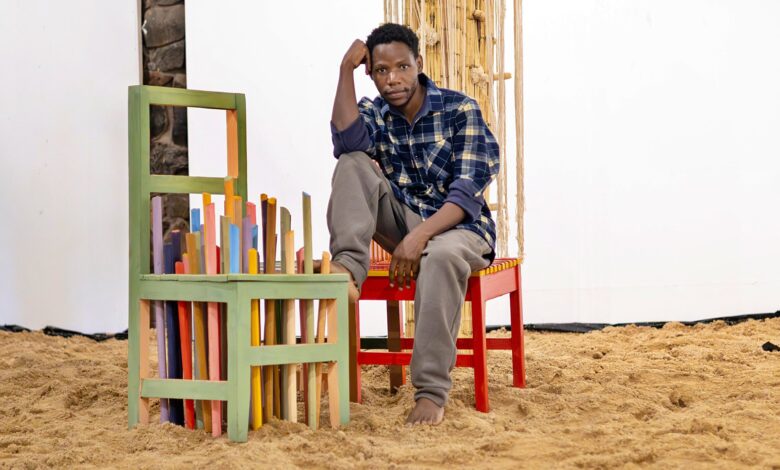
Zimbabwean artist Lomedy Mhako opened his solo exhibition, Kushambidzwa: Lines of Discomfort, at Mbare Art Space on Friday, 20 February 2026, attracting a diverse audience of art enthusiasts, creatives, and cultural practitioners. Curated by Tafadzwa Mushayi, the exhibition frames cleansing not as a pursuit of purity but as a confrontation with discomfort embedded in everyday life. Set against a backdrop of economic instability, social fatigue, and emotional imbalance, the show challenges audiences to face disorder before attempting resolution. Mhako positions cleansing as an ethical act of recognition, insisting that acknowledging discomfort within social, political, and economic structures is necessary for reflection and growth. The exhibition immediately signals that this is not a conventional viewing experience but an immersive encounter demanding attention, presence, and humility.
From the moment visitors enter, the exhibition engages the body as much as the mind. Guests are asked to remove their shoes and step onto river sand, a gesture that goes beyond gallery etiquette into symbolic unburdening. Removing shoes represents a temporary shedding of daily roles, authority, professional identity, parental responsibility, and social expectation. In this state, the body becomes receptive, creating a shared sense of humility and vulnerability among participants. Mhako’s deliberate use of spatial and bodily interaction establishes a platform where audience and artwork exist in a relational exchange, emphasizing the connection between personal experience and broader social structures.
Lomedy Mhako’s multidisciplinary practice spans installation, object-based work, and a collaborative painting process with his mother, Sipiwe Mhako, termed kudzura. This approach resists confinement to a single medium, embracing instability and unpredictability as methods that reflect the uncertainties of social systems. Linear structures recur throughout the exhibition, with vertical alignments, repeated forms, and controlled formations suggesting human intervention in everyday life. While these lines convey discipline and order at first glance, their stability is questioned, inviting viewers to interrogate the fragility underlying apparent control. This tension between perceived order and potential collapse mirrors the precarity present in broader societal structures.
Domestic objects form a central vocabulary within Kushambidzwa. Chairs, mops, pegs, brooms, and cooking tools are presented not merely as functional items but as rurimi rwamai, or mother’s tongue. These objects signify foundational learning through repetition, care, and labor long before formal education begins. They carry memory, discipline, and embodied knowledge, linking everyday domestic practice with socialization and internalized systems of order. By arranging these materials into structured vertical formations, Mhako reflects the ways human beings navigate and sustain societal frameworks that are both enduring and rarely questioned. The exhibition turns these familiar items into a lens through which visitors can examine power, routine, and their own participation in systemic structures.
Kushambidzwa resists easy resolution or didactic interpretation. Rather than offering answers, it emphasizes acknowledgment before healing, suggesting that comfort, or kunyaradzwa, arises not through erasure but through shared awareness and collective witnessing. Functioning less as a conventional display and more as a participatory ceremony, the exhibition invites reflection, humility, and active engagement. The opening drew attendees from multiple sectors, who praised Mhako’s creativity and the exhibition’s capacity to provoke thought and introspection. Mhako noted the importance of local materials in his practice, emphasizing that their resonance allows audiences to connect directly with the work and become part of its artistic process.
Kushambidzwa: Lines of Discomfort positions Lomedy Mhako as a key voice in contemporary Zimbabwean art, blending installation, object-based work, and personal history into a cohesive exploration of vulnerability, order, and societal tension. The exhibition challenges audiences to confront discomfort and reconsider the stability of familiar systems, both personal and social. By engaging visitors bodily and emotionally, Mhako transforms the gallery into a space of participation, reflection, and ethical reckoning. Through domestic objects, linear structures, and collaborative processes, the work links memory, labor, and care with broader cultural and social narratives. Kushambidzwa leaves audiences with a profound understanding that acknowledgment of discomfort is the first step toward insight, connection, and collective experience.